
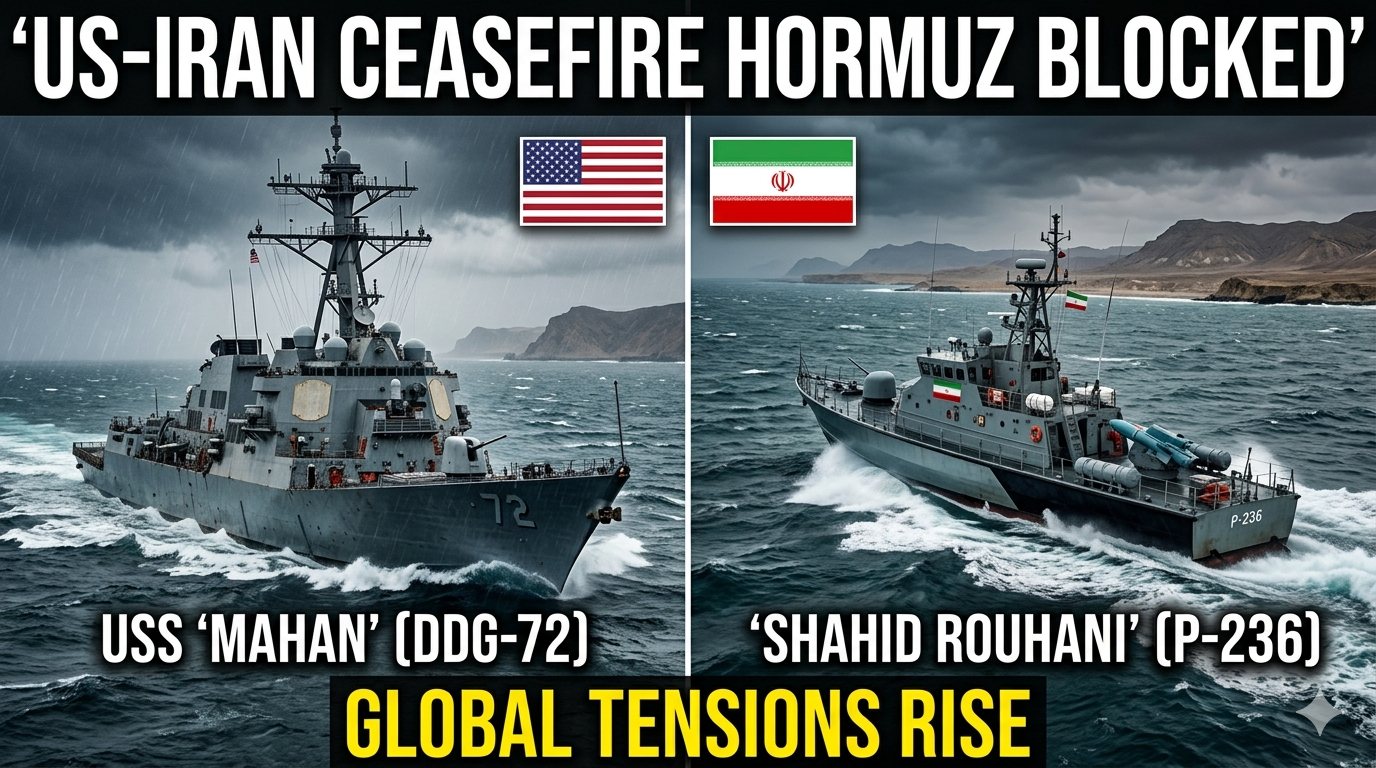
US-Iran ceasefire Hormuz blocked developments are creating uncertainty across global markets as conflicting claims from both sides continue to emerge. Despite announcements of a temporary truce, the situation on the ground remains tense, with the strategically vital Strait of Hormuz still facing restrictions.
Recent reports indicate that while the United States claims progress toward de-escalation, Iran maintains control over access to the waterway, raising questions about the effectiveness of the ceasefire.
Conflicting Narratives Over Ceasefire
The US-Iran ceasefire Hormuz blocked issue highlights a growing divide in how both nations interpret the agreement. The administration of Donald Trump has suggested that the ceasefire includes provisions for reopening the Strait of Hormuz.
However, Iranian officials have signalled that reopening the strait is conditional and remains under their authority. In fact, some reports suggest that only limited ship movements are currently allowed, subject to Iranian approval.
This divergence in messaging has complicated diplomatic efforts and added to global uncertainty.
Why the Strait of Hormuz Matters
The US-Iran ceasefire Hormuz blocked situation is particularly critical because the Strait of Hormuz is one of the world’s most important energy corridors. Roughly 20% of global oil supply passes through this narrow waterway, making any disruption a major concern for international markets.
Even with the ceasefire in place, shipping companies remain cautious. Major firms have not fully resumed operations due to security concerns and lack of clarity on safe passage.
Also Read:
JD Vance Iran Talks Pakistan: US Delegation Heads to Islamabad for Critical Negotiations
Pakistan’s Diplomatic Efforts
Pakistan has played a key role in mediating the US-Iran ceasefire Hormuz blocked crisis. Diplomatic efforts led from Islamabad helped bring both sides to agree on a temporary pause in hostilities.
However, despite these efforts, fundamental disagreements remain unresolved—particularly regarding control and reopening of the Strait of Hormuz.
Pakistan’s mediation continues to be seen as crucial in preventing further escalation and keeping communication channels open.
Ongoing Tensions Despite Ceasefire
Although a two-week ceasefire has been announced, the US-Iran ceasefire Hormuz blocked reality suggests that tensions are far from over. Reports indicate continued military activities and regional instability, including strikes involving allied groups.
Iran has also reportedly resisted pressure to reopen the strait as part of a temporary deal, insisting on broader conditions for a long-term agreement.
This ongoing standoff underscores the fragile nature of the current truce.
Global Economic Impact
The US-Iran ceasefire Hormuz blocked situation has already impacted global oil markets. Prices initially surged due to supply fears, and while they have slightly stabilized following ceasefire announcements, uncertainty continues to affect investor confidence.
Shipping disruptions and rerouted logistics have added further strain to global trade networks, increasing costs and delays.
What Lies Ahead?
The future of the US-Iran ceasefire Hormuz blocked crisis depends largely on upcoming negotiations. Both sides are expected to engage in further talks to clarify terms and address key issues, including maritime security and sanctions.
Experts warn that unless a clear and mutually agreed framework is established, the ceasefire may collapse, leading to renewed conflict and deeper global consequences.
WhatsApp Channel Link:
https://whatsapp.com/channel/0029Vb7drdQL2AU5NODWlX3U
Conclusion
The US-Iran ceasefire Hormuz blocked situation reflects the complexity of modern geopolitical conflicts. While a ceasefire offers a temporary pause, conflicting claims and unresolved issues—especially surrounding the Strait of Hormuz—continue to pose significant challenges.
As diplomatic efforts continue, the world watches closely, aware that the outcome will have far-reaching implications for global stability, energy security, and international relations.
FAQs:
1. What does US-Iran ceasefire Hormuz blocked mean?
It refers to the situation where a ceasefire exists, but the Strait of Hormuz remains restricted or partially closed.
2. Why is the Strait of Hormuz important?
It is a key global oil route through which about 20% of the world’s oil supply passes.
3. Has the Strait of Hormuz fully reopened?
No, reports suggest limited access and continued control by Iran.
4. Who is mediating the US-Iran conflict?
Pakistan is playing a major role in facilitating negotiations.
5. What happens if the ceasefire fails?
Failure could lead to renewed conflict and major disruptions in global energy markets.
Official Website Link:
Disclaimer:
This article is based on the latest available news reports and may evolve as new information emerges. Readers should verify updates through official government and international sources.
1 thought on “US-Iran Ceasefire Hormuz Blocked: Conflicting Claims Raise Global Tensions”